New Global Art Technician Research: Pay, Pathways & Professional Insight Across the US & UK
Authors:
Ben Clark, Group CEO, Cadogan Tate
Rosie Allan, Managing Partner, Sophie Macpherson Ltd.
This research provides the most comprehensive data-led picture of the profession as it stands today. Including salaries and hourly rates across the field, how training, education, and experience shape career outcomes; and highlighting actionable recommendations to strengthen the sector and support its workforce.
Join us for a Discussion about the Art Technician Research with Cadogan Tate & SML
Tuesday, December 2nd 10am ET / 3pm GMT
In this webinar we’ll be giving an overview of the key insights and a discussion of the issues and opportunities for Art Technicians and those who employ them.
Speakers:
- Rosie Allan, Managing Partner, Sophie Macpherson Ltd.
- Zach Botham, Chief Art Technician, Cadogan Tate
- Steve Fuller, Head of Operations, Pilar Corrias
Art Technicians Talent Report 2025 Cadogan Tate | SML
Art Technicians form the hidden infrastructure of the global art world, responsible for the safety, movement, and installation of its most valuable works. This report, a collaboration between Cadogan Tate, leading specialist in art logistics with extensive global operations across commercial art spaces, museum environments, and interior design, and art world talent specialists Sophie Macpherson Ltd, offers the most comprehensive overview to date of pay, job satisfaction, and career progression among Art Technicians working across the United Kingdom and the United States.
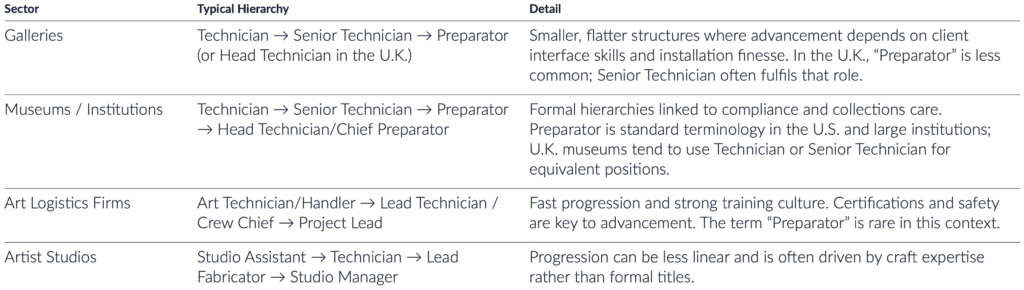
Workforce Structure and Terminology in the Art Technician Sector
The art technician workforce is diverse in both structure and terminology. While titles differ across organisations and geographies, most positions fall within a series of overlapping functional categories, reflecting shared responsibilities rather than formal rank or seniority.
Source: Cadogan Tate x SML Art Technicians Report
What are Art Technicians / Handlers?
Entry to Mid-Level
Art technicians/handlers are responsible for the safe handling, packing, transport coordination, and installation of artworks. Their day-to-day work includes the physical handling of artworks, preparation of packing materials, loading and unloading shipments, and executing installations under supervision. They work closely with senior colleagues, following established protocols for condition reporting, documentation, and safety procedures. These roles form the operational foundation of art handling,requiring careful attention to detail, technical skill, and growing knowledge of materials and handling techniques.
What are Senior Art Technicians / Handlers?
Experienced Practitioners
Senior art technicians/handlers have demonstrated expertise in complex installations, advanced rigging techniques, and condition assessment. They are often responsible for supervising teams on-site, liaising directly with clients, curators, or registrars, and making technical decisions about installation approaches. Senior Technicians train junior colleagues, address unexpected challenges on site, and may lead project teams for exhibitions, fairs, or collection moves. The role requires strong problem-solving abilities, client communication skills, and the confidence to work autonomously or manage small crews.
What are Art Head Preparators/Head Technicians?
Senior Leadership
These are senior leadership positions responsible for departmental management, strategic planning, budgets, and organisational policy. These roles bridge technical operations and organisational leadership, overseeing teams of Preparators and Technicians, managing relationships with curatorial and conservation departments (within institutional contexts), and setting standards for technical practice. They are responsible for staff development, health and safety compliance, long-term planning for facilities and equipment, and representing technical operations in decision-making.
What are Art Preparators?
Within an Institutional or Gallery Context
In the U.S., the title Preparator is widely used across museums and galleries to describe technicians responsible for installations, collections care, and exhibition coordination. Preparators work closely with conservation and curatorial departments, overseeing documentation, procedural adherence, and the long-term management of objects on display and in storage. They maintain installation records, coordinate with multiple departments, ensure compliance with institutional standards, and often manage exhibition timelines and technical requirements.
In the U.K., comparable responsibilities typically fall under titles such as Technician, Museum Technician, or Collection Technician. While the terminology differs, the core functions are largely equivalent, combining technical handling expertise with oversight of collections care, exhibition delivery, and cross-departmental coordination.
Key Findings From the Cadogan Tate & SML Art Technician Research
Sources:
- Cadogan Tate x SML Art Technicians Report (conducted in 2025)
- Advertised salary ranges from art world job postings across 2024-2025
- Anonymous SML Candidate Dataset from 2024-2025
Art Technician Salary & Compensation Benchmarks
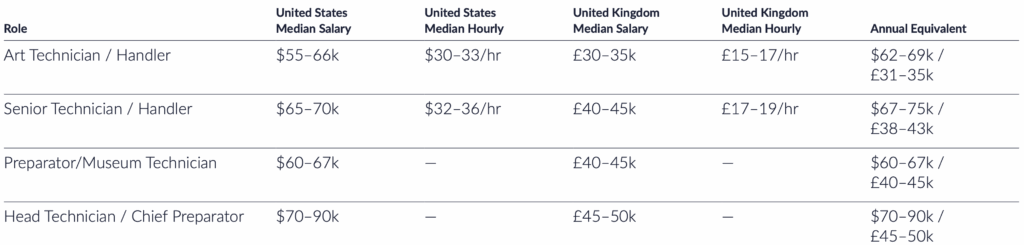
Below is a clear view of how compensation varies across roles, organisations, and levels of experience. All figures represent median values unless otherwise stated, providing a clear view of typical earnings rather than outliers. The data reveals not only what technicians earn, but how pay varies by employer scale, sector, and career stage, and where the gaps and opportunities lie.
Art Technician Salary by Role and Region
Source: Cadogan Tate x SML Art Technicians Report
Art Technician Salary by Experience
Because job title hierarchy can be opaque, especially when reviewing cross sector, we have also presented median salaries against years’ experience. Pay progression follows a clear pattern across both markets, with median earnings rising with each experience tier to reflect the growing complexity and responsibility of work – roughly 10–15% growth per experience tier.

Source: Cadogan Tate x SML Art Technicians Report
Art Technician Salary by Company Size & Sector
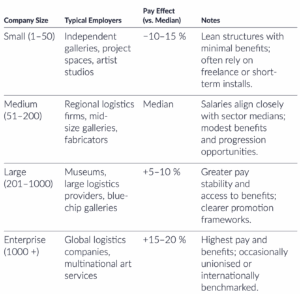
By sector, museums offer the highest job security and benefits, logistics firms offer the highest pay and progression speed, and galleries the greatest variability. Small galleries often pay below market average, whereas top-tier international “mega” galleries now compete directly with museums and logistics companies on compensation and benefits.
Source: Cadogan Tate x SML Art Technicians Report
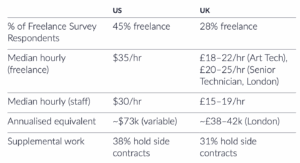
Art Technician Supplemental Work Pay Rates
Roughly one-third of respondents, both freelance and salaried, reported taking on supplemental work, suggesting that additional income is often necessary to sustain Art Technicians’ overall earnings. One respondent from the U.S. said, “With increasing cost of living, my salary has become an unlivable wage.”
Source: Cadogan Tate x SML Art Technicians Report
Art Technician Training, Education & Skill Development
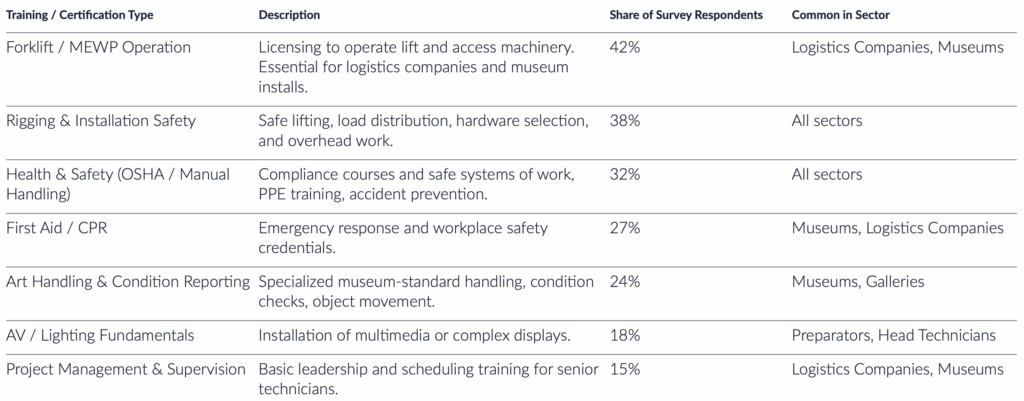
For technicians in logistics companies, certification isn’t optional, it’s a requirement embedded in insurance contracts, client specifications, and regulatory compliance. Forklift licences, MEWP operation, rigging qualifications are prerequisites. In this context, training is both a professional necessity and a marker of employer investment.
Our survey data reveals a technically skilled and highly educated workforce, with clear links between training access, compensation, and job satisfaction. What emerges is a profession where investment in development directly predicts retention, yet access to that development remains unequal.
Degrees and Art Technicians
The Art Technician workforce is highly educated, with a majority (78%) holding university degrees. 36% of all survey respondents hold degrees in Fine Art, while others studied Design, Art History, or related creative disciplines.
This reveals a workforce where a substantial proportion of technicians are not only handling art, but they are also artists themselves or at least have formal training in artistic practice.
As one U.K.-based Art Technician working in art logistics noted, “You can teach skills but you can’t teach interest. Without an interest there is a lack of care.”
This comment captures a broader sentiment from our research that genuine engagement with art fosters higher standards of care, attentiveness, and pride in the work itself. Recognising and nurturing that intrinsic motivation can strengthen both team culture and client trust.
Art Technicians Certifications
Training participation varies significantly across employer types, reflecting differences in regulation, funding, and operational scale.
Source: Cadogan Tate x SML Art Technicians Report
Art Logistics Company Art Technician Certifications and Training
Around 60% of respondents employed in logistics companies report formal training or certification. These programmes are typically safety- and compliance-driven, covering forklift and MEWP operation, rigging, manual handling, and site-safety protocols. Such training is often mandated by insurance or accreditation requirements, making logistics companies the most consistently trained segment of the Art Technician workforce.
Museums & Institutions Art Technician Certifications and Training
Around 35% of technicians working in museums or public institutions report formal training participation. Programmes typically focus on manual handling, collections care, and institutional safety standards, often delivered through conservation or facilities departments. While museums may offer fewer certifications than logistics companies, their training is procedural and policy-aligned, ensuring compliance with institutional standards for artwork care and safety.
Commercial Gallery Art Technician Certifications and Training
Around 25% of gallery-based Art Technicians report employer-funded training. Galleries often expect technicians to arrive pre-certified or self-fund external courses, particularly for rigging and safety. Smaller budgets and lean teams mean that most training occurs informally, on the job, rather than through structured programmes.
Art Technician Diversity, Gender & Pay Equity
The art technician workforce shows strong gender pay parity within equivalent roles, though representation remains skewed toward male technicians.
Art Technician Sector Gender Pay Equity
There is an observed 2–3% difference that falls within normal variance and does not indicate systematic unequal pay for equal roles in this sample. When controlling for role title and years of experience, male and female respondents report broadly equivalent earnings.
The data also reveals clear differences in representation across sectors. Female Art Technicians are more present in galleries and museums, where roles often combine technical handling with registrarial or collections-care responsibilities. By contrast, art logistics companies remain more male-dominated.

Source: Cadogan Tate x SML Art Technicians Report
Art Technician Sector Diversity
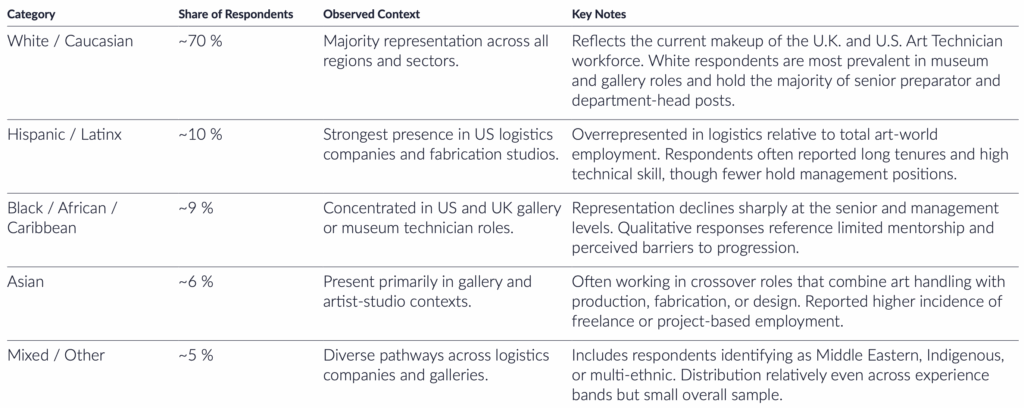
Survey figures suggest that art logistics companies show slightly higher diversity than galleries and museums, which remain majority white. Respondents cited lack of outreach, informal recruitment (reliance on word- of-mouth or internal referrals), and low visibility of role models as barriers to entry and progression.
Source: Cadogan Tate x SML Art Technicians Report
Strategic Insights: Art Technician Diversity, Gender & Pay Equity
While pay within comparable roles appears broadly equitable, the data reveals a representation gap rather than a pay gap. Barriers to progression and the concentration of under-represented groups within specific sectors point to structural, not individual, inequities.
Expanding mentorship and peer-network initiatives could help strengthen retention and advancement, particularly for early-career technicians. At the entry level, partnerships with technical colleges, arts universities, and apprenticeship programmes would widen recruitment pipelines and diversify candidate pools. To sustain progress, employers should commit to regular diversity tracking and reporting within technician teams, enabling consistent benchmarking and evidence-based improvement over time.
Art Technician Job Satisfaction & Benefits
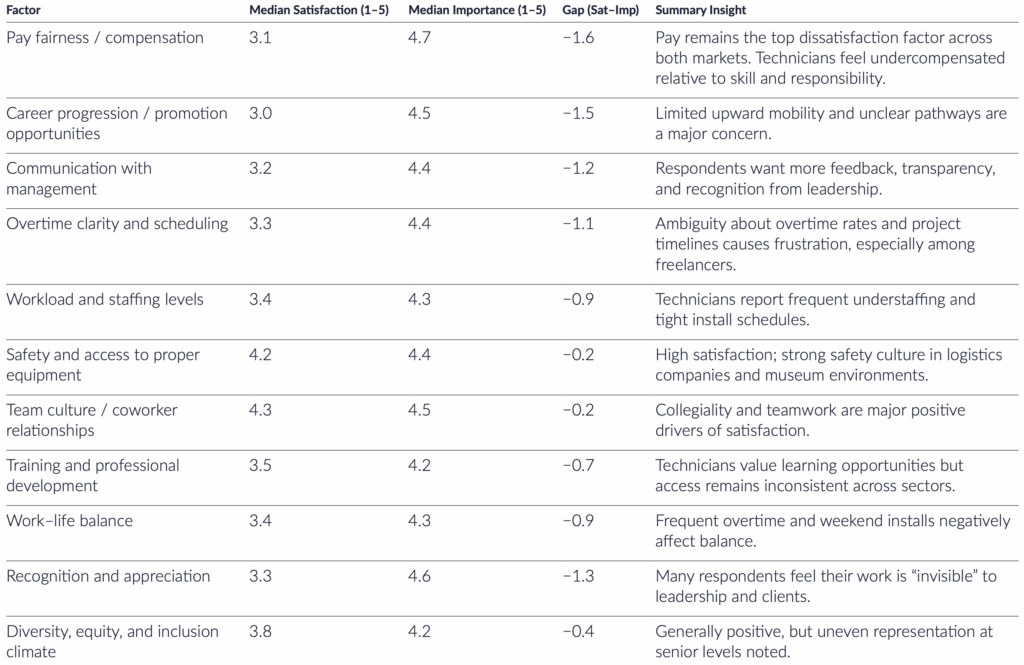
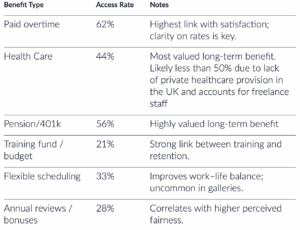
From our research we found that Art technicians report high pride in teamwork, safety, and the quality and impact of their work, but experience gaps wherever reward and recognition systems lag, in pay, progression, communication, and credit. Addressing the operational drivers (scheduling, staffing, overtime transparency) while formalising development pathways is the most direct route to closing the largest satisfaction gaps highlighted across every factor in the survey.
Source: Cadogan Tate x SML Art Technicians Report
Strategic Insights: Art Technician Job Satisfaction & Benefits
The survey results reveal a workforce deeply engaged in its work but seeking stronger recognition and clearer pathways for advancement. Visibility matters as much as pay. Art Technicians want to see their expertise acknowledged and their careers treated as structured, valued professions.
A strong safety culture, particularly within logistics and museum environments, remains a defining strength and source of pride across the field. Yet pay and progression continue to lag, emerging as the most common drivers of dissatisfaction and turnover intent. Access to training and certification proves decisive; technicians offered funded training or time off for professional development consistently report higher satisfaction, morale, and retention.
Source: Cadogan Tate x SML Art Technicians Report
Art Technician Career Progression
The art technician profession is evolving quickly. Rising demand for experienced technicians, fuelled by museum exhibitions and programmes, global exhibition circuits and art fairs, and the increasing scale and complexity of art logistics operations, continues to outpace supply.
Art handling remains a physically demanding and precision-driven occupation. Retention challenges persist, particularly among mid-career technicians who struggle to see clear progression beyond Senior Technician or Head of Department and Crew Chief levels. After five to eight years of building expertise, technicians can find themselves facing a professional crossroads. Pay rises level off, managerial opportunities are scarce, and the physical toll of the work becomes more pronounced.
For those without a clear path into senior roles, the options narrow: stay in a role that has plateaued, transition out of the sector entirely, or move laterally into related but less specialised positions. This mid-career squeeze is reflected in survey comments describing frustration with static salaries, limited recognition, and the absence of formal development structures.
The feedback, “Don’t stay here too long. Get some experience, upskill and move on,” from a Packing Manager in the United Kingdom, captures this sentiment plainly. It’s advice born from experience and recognition that advancement often requires leaving, rather than a reward for loyalty and accumulated skill.
Despite these challenges, the findings highlight strong foundations for long-term professionalisation. Training pathways are expanding; pay equity is improving; and a growing cohort of technicians view their roles not as temporary jobs but as structured, skilled careers.
Recommendations to Improve the Art Technician Sector
Pay structures are stabilising, and training is increasingly recognised as essential to professional development, and technicians themselves are advocating for transparency and equity with growing confidence. What follows outlines the key trends shaping the field, actionable recommendations for employers and technicians, and a view toward the sector’s continued evolution as a structured, recognised career pathway within the global art world.
Key Trends to Watch:
- Professionalisation through training: Formal certification is becoming the gateway to higher pay and promotion, mirroring patterns in other technical trades.
- Pay transparency: Published salary benchmarking, including this report, is accelerating standardisation across organisations.
- Cross-sector mobility: Technicians are increasingly moving between galleries, museums, and logistics companies, creating a shared skills market and blending cultures of compliance and creativity.
Recommendations for Employers
- Clarify progression pathways: Clear, transparent career structures are central to retention. Employers can strengthen trust and motivation by defining technician levels and linking each to consistent pay bands and promotion criteria. Establishing viable pathways helps Art Technicians understand how experience, training, and responsibility translate into advancement, while also supporting equity and pay transparency across teams and locations.
- Promote recognition and visibility: Art Technicians play a critical role in realising exhibitions, managing risk, and protecting collections, yet their work often remains behind the scenes. Employers can strengthen belonging and morale by recognising technical contributions publicly and internally. Visibility helps build pride in the profession and reinforces respect for the skill and precision required in this work.
- Invest in accredited training: Training is one of the strongest predictors of job satisfaction and retention. Employers that fund or provide paid time off for external certifications see measurable gains in engagement and morale. Beyond compliance, accredited training signals that technical expertise is valued, builds consistency across teams, and raises safety and client-service standards throughout the organisation.
- Develop shared training standards: The Art Technician field would benefit from a common training language across galleries, museums, and art logistics companies. A modular, accredited framework covering core competencies such as handling, rigging, health and safety, would help professionalise the field, reduce redundant training costs, and make hiring more consistent. Shared standards would also strengthen the portability of skills between business types, giving Art Technicians clear, recognised milestones for career development.
- Encourage pay transparency: Publishing salary benchmarks with job postings (already a legal requirement within several states in the U.S.), helps normalise open discussion around pay and supports equitable, data-driven decision-making. Transparency encourages fairness both within and between organisations, helping narrow disparities across gender, geography, and employer type. For employers, it also builds trust and strengthens reputation, demonstrating alignment with evolving expectations of accountability and workplace culture across the arts.
- Support diversity in recruitment: Broadening access to Art Technician roles begins with how and where positions are advertised. Employers should share vacancies beyond established networks and introduce mentorship for new hires to support long-term inclusion. These measures help open the field to a wider talent pool, enrich team perspectives, and build stronger, more sustainable pipelines for the next generation of technicians.
Recommendations for Art Technicians
- Maintain and update professional certifications: Professional certifications are increasingly viewed as essential credentials for advancement and insurance compliance. Art Handlers and Technicians should maintain up-to-date records of their formal qualifications, such as forklift operation, rigging, or MEWP certification, and renew them on a regular cycle. These credentials increasingly function as core professional currency, required for insurance compliance and eligibility for senior or specialist roles. Staying current signals professionalism, improves safety, and ensures readiness for high-value projects.
- Document and communicate experience: Beyond formal credentials, technicians build deep, situational expertise through years of complex installations, problem-solving, and client interaction. Recording this experience, whether through project portfolios, digital logs, or reflective summaries, helps evidence leadership, adaptability, and technical authority. Sharing this knowledge within teams, peer networks, or professional forums reinforces collective learning and raises the visibility of Art Technicians’ work as a skilled, intellectually engaged practice.
- Engage in networks and advocacy: Peer networks and online forums remain vital spaces for technicians to exchange knowledge, share opportunities, and advocate for fair conditions. Engagement in these communities (such as Taoi) supports continuous professional learning while amplifying Art Technician voices in conversations about safety, training, and pay. Active participation in such networks helps shape a stronger, more unified professional identity across the art-handling field.
Why This Research Matters for the Global Art World
Art Technicians form the operational core of the art world. They are skilled professionals whose expertise underpins every art fair, exhibition, collection move, and artwork installation. The sector stands at a turning point: more visible, more data-driven, and more unified than at any time before. The findings of this report point toward a profession consolidating its status as a skilled trade, and one deserving of recognition, structure, and sustainable working conditions.
The data shows a field that is maturing in parity and professionalism yet still contending with issues of visibility, access to professional development, and recognition. What stands out most is the passion and pride Art Technicians bring to their work. Across all contexts, respondents emphasise a commitment to excellence, safety, and collaboration that defines the profession’s culture.
The future of the art handling field lies not only in pay equity and professional standards, but in valuing the people who make every exhibition possible. Continued investment in training, transparent career pathways, and inclusive recruitment will establish the framework for a more equitable workforce, while industry-wide respect, recognition, and trust in Art Technicians will ensure its long-term vitality.
A Final Word
To find additional qualitative and quantitative detail on the Art Technician sector, please download the pdf of our full report.
We also invite you to explore the Cadogan Tate website for your future art logistics needs:
“Our vision is to perfect the art of caring for the world’s most valued possessions”
Related Articles

Lucy Bishop, the Fashion Auctioneer

Inside the World of PAD

Nicole Darnell of Design Miami on Success…